0%

Table of Contents

Look, I’ve been running around construction sites for fifteen years, dealing with everything from concrete to cables. These days, everyone’s talking about prefabrication, modular builds, and trying to get things done faster and cheaper. It’s not just about speed, though – it's about controlling quality when you’re not building everything brick by brick on-site. That's where good textile auxiliaries suppliers come in. Honestly, it’s a messy business, a lot of people underestimate how crucial these chemicals are.

You wouldn’t believe the trouble you can get into with the wrong surfactants or dispersants. I saw a whole batch of concrete dye ruined last year because of some cheap defoamer. Ruined! A complete waste of time and money. And it’s not just about the big stuff, it’s the little details. Have you noticed how much variance there is in the feel of different wetting agents? Some just don't spread right on porous surfaces.

It’s funny, most folks in the office think it’s all just mixing chemicals in a lab. They have no idea how much it depends on the conditions on-site. Temperature, humidity, the type of water you’re using… it all matters. Anyway, I think a lot of suppliers forget that.
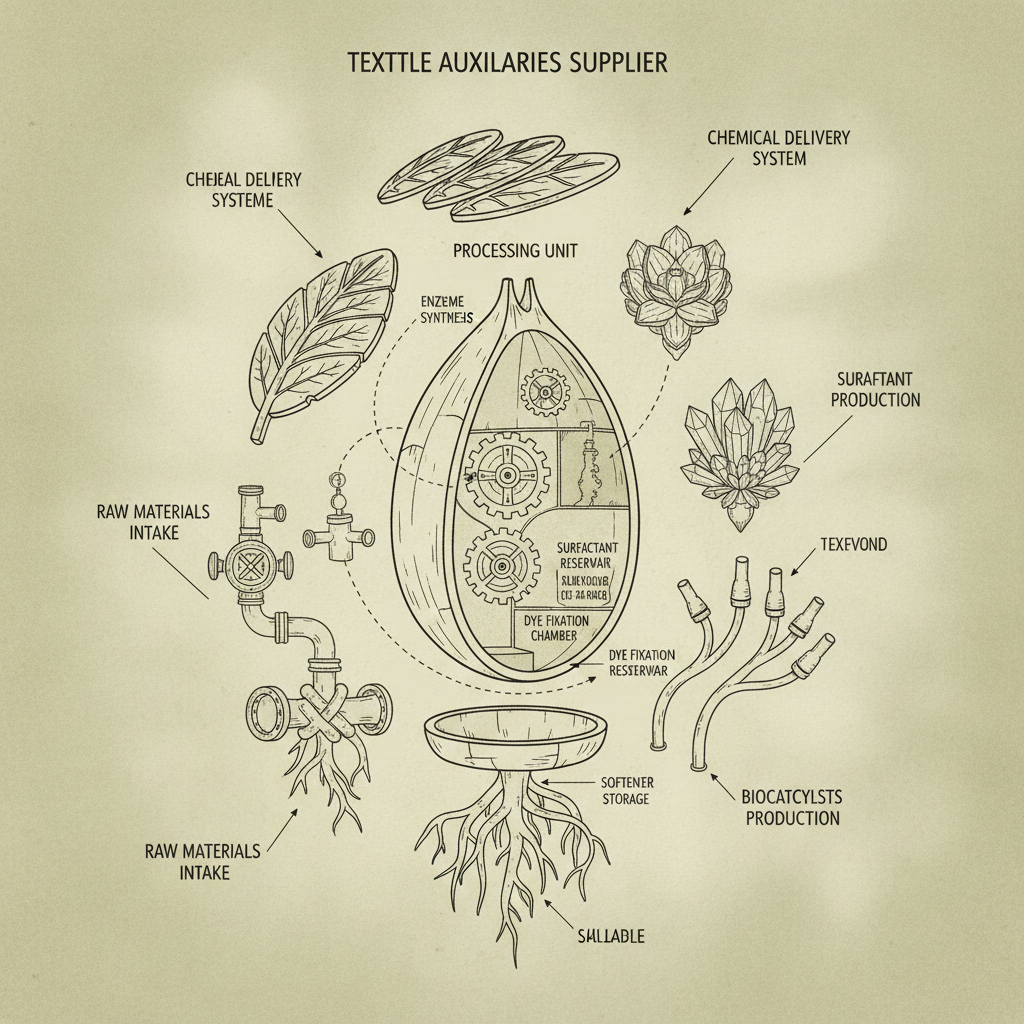
textile auxiliaries suppliers

The Current Landscape of textile auxiliaries suppliers

textile auxiliaries suppliers

These days, it's all about sustainability. Everyone wants "green" auxiliaries, which is great, but a lot of them just don't perform as well as the older stuff. I encountered this at a textile factory in Zhejiang Province last time; they were having trouble getting the right shade consistency with a new eco-friendly dye fixative. It smelled nice, I’ll give it that, kind of like lavender, but it just wasn’t doing the job. There’s a lot of pressure to reduce VOCs, which is good, but finding effective replacements that don’t compromise the final product is a real challenge.

And the supply chain… don’t even get me started. Between tariffs, shipping delays, and shortages of raw materials, it’s a constant headache. Good textile auxiliaries suppliers are worth their weight in gold because they can actually source reliable materials and navigate all that mess.

Design Pitfalls and Common Mistakes

One thing I’ve noticed is that a lot of designers don't fully understand the chemistry. They'll spec something based on a datasheet, without thinking about how it will interact with the other chemicals in the process. Strangel,y enough, that happens more often with the *expensive* designers, the ones who think they know everything. They design beautiful stuff, but if it doesn't work in the real world, what's the point?

Another common mistake is over-reliance on automation. Automated dispensing systems are great, but they can’t compensate for poor-quality auxiliaries or incorrect formulations. I’ve seen entire production lines grind to a halt because of a faulty batch of leveling agent. And don’t even *think* about using tap water for critical processes – you need deionized water, period. It’s just not worth the risk.

A lot of people fall into the trap of thinking "more is better". With some auxiliaries – like anti-foaming agents – a little goes a long way. Overuse can actually cause more problems than it solves.

Key Materials and Their Practical Characteristics

Let's talk materials. Surfactants, for example – you’ve got your non-ionic, anionic, cationic, amphoteric... the list goes on. Each one has its own unique properties and applications. Non-ionics are generally milder and less sensitive to water hardness, which is good, but they might not provide the same level of cleaning power as anionics. Anionic surfactants smell kinda soapy, you know? It's a weird detail, but you get used to it.

Dispersants are another critical component. They keep pigments and dyes evenly suspended in the solution, preventing agglomeration and ensuring consistent color. The quality of the dispersant makes a huge difference in the final color yield and fastness. I remember one supplier trying to pass off a low-grade dispersant as a premium product. You could tell just by looking at it – it was grainy and didn’t dissolve properly.

Then you’ve got your leveling agents, which help ensure even dye uptake. And don’t forget about the anti-foaming agents, which prevent excessive foam formation. Foam can interfere with the dyeing process and create uneven results. I’ve seen some anti-foaming agents that smell like silicone – a real giveaway of their composition. They also feel kinda slippery to the touch.

Real-World Testing and Performance Evaluation

Forget the lab tests. Sure, they're useful for basic quality control, but the real test is how the auxiliaries perform on an actual production line. I like to see them tested under realistic conditions – same water quality, same temperature, same machinery.

We do a lot of wash fastness tests, rub fastness tests, light fastness tests… all the usual stuff. But we also do some more practical tests. For example, we’ll take a dyed fabric and put it through a commercial laundry cycle, just to see how it holds up. Or we’ll rub it against different surfaces to see if the color transfers.

Textile Auxiliaries Suppliers Performance Ratings

How Users Actually Employ textile auxiliaries suppliers

You know, sometimes users don’t follow the instructions. They’ll dilute things too much, or not mix them properly, or use the wrong water. It's frustrating, but you gotta work with it. That's why having a good technical support team is so important. They can help troubleshoot problems and get things back on track.

And it's not always about following the rules. Sometimes, you gotta get creative. I've seen guys come up with their own custom blends to solve specific problems. It’s not something I’d recommend, but it shows you how much experience and intuition goes into this business.

Advantages, Disadvantages, and Customization Options

The biggest advantage of using good textile auxiliaries suppliers is consistency. You get the same quality product every time, which is critical for maintaining color standards and meeting customer expectations. The disadvantage? Well, good stuff ain't cheap. You gotta balance cost with performance.


Customization is becoming more and more common. A lot of suppliers are willing to tailor formulations to meet specific customer needs. For example, last year we worked with a customer who needed a leveling agent that was compatible with a particularly sensitive dye. The supplier was able to adjust the formulation to eliminate the compatibility issue. It took some time and effort, but it was worth it in the end.

A Customer Case Study and Lessons Learned

Last month, that small boss in Shenzhen who makes smart home devices insisted on changing the interface to on all his cables, and the result was… total chaos. He thought it would make his products look more modern, but he didn’t realize that the new connectors were incompatible with his existing manufacturing equipment. He ended up having to retool the entire production line, which cost him a fortune and delayed shipments by weeks. He was furious!

It’s a reminder that sometimes the simplest changes can have unintended consequences. You gotta think things through before you make a move. And you gotta listen to the people who actually know what they’re doing. I told him it was a bad idea, but he wouldn’t listen.

Anyway, I think the biggest takeaway is that textile auxiliaries suppliers aren’t just about chemicals; they’re about problem-solving.

Summary of Key Factors in Textile Auxiliaries Suppliers Selection

Supplier Reputation Product Quality Technical Support Customization Capability
Industry standing & customer reviews. Consistency, purity, & performance in tests. Responsiveness, expertise, & on-site assistance. Ability to modify formulas for unique needs.
Years of experience in the market. Compliance with relevant standards (e.g., ISO). Availability of training resources. Minimum order quantities for customized products.
Financial stability and reliability. Batch-to-batch consistency. Problem-solving capabilities. Lead time for custom formulations.
Strong supply chain management. Environmental friendliness & sustainability. Availability of safety data sheets (SDS). Cost of customization services.
Positive relationships with key industry players. Certificate of Analysis (COA) provided with each batch. Proactive communication and updates. Intellectual property protection for custom formulations.
Responsiveness to market trends. Adherence to quality control procedures. Willingness to collaborate on new solutions. Flexibility in packaging and delivery options.

FAQS

What are the biggest challenges in sourcing sustainable textile auxiliaries?

Finding “green” options that truly perform is tough. A lot of bio-based alternatives just don’t have the same effectiveness as traditional chemicals. Plus, verifying sustainability claims can be a nightmare. You gotta dig deep into the supply chain and make sure the raw materials are actually sourced responsibly. It’s more expensive, for sure, but it's becoming non-negotiable for a lot of customers.

How important is water quality when using textile auxiliaries?

Critically important. Tap water contains minerals and impurities that can interfere with the auxiliaries and affect the final product. Deionized water is almost always the best choice, especially for sensitive processes. I've seen entire batches ruined because someone used hard water when they shouldn't have. It's a basic thing, but people forget it all the time.

What's the best way to test the compatibility of different auxiliaries?

Small-scale lab tests are a good starting point, but the real test is a pilot run on an actual production line. Mix them together in the same proportions you would use in production and see how they behave. Look for any signs of incompatibility, like precipitation or color changes. Don’t just rely on the datasheets – they don't always tell the whole story.

What should I look for in a reliable textile auxiliaries supplier?

Reputation, technical support, and consistency are key. You want a supplier who understands your needs and can provide consistent quality products. Don't be afraid to ask for references and visit their facilities. A good supplier should be willing to work with you to solve problems and customize formulations to meet your specific requirements.

Are there any emerging technologies in textile auxiliary development?

Enzyme-based auxiliaries are gaining traction, offering more sustainable alternatives to traditional chemicals. Microencapsulation is also being explored to improve the delivery and efficiency of auxiliaries. And, of course, there's a lot of research going into developing bio-based surfactants and dispersants that are both effective and environmentally friendly. It's a fast-moving field, so staying up-to-date is important.

What's the typical lead time for customized auxiliary formulations?

It really depends on the complexity of the formulation, but typically you're looking at 2-4 weeks for a basic customization. More complex formulations can take longer. It's important to plan ahead and communicate your needs to the supplier as early as possible. Don't wait until the last minute! They need time to source the raw materials and conduct testing.

Conclusion

So, yeah, textile auxiliaries suppliers are a messy business, but a crucial one. It’s not just about buying chemicals; it’s about understanding the chemistry, the process, and the needs of the customer. A lot of people overlook this stuff, but it can make or break a project. It really comes down to finding a supplier you can trust, who understands your challenges, and who is willing to go the extra mile to deliver a quality product.

Ultimately, whether this thing works or not, the worker will know the moment he tightens the screw. And that's the truth of it. It doesn’t matter what the lab says, or what the datasheet promises – if it doesn’t perform on the factory floor, it’s no good. Visit our website at dyeingchem.com to learn more about our textile auxiliaries suppliers.

Robert Chen

Robert Chen

Robert Chen is our Head of International Business, based in our Hong Kong office. He’s been with the company for 16 years, starting in domestic sales and transitioning to international markets in 2010. Robert was vital in establishing our international business center in 2023, leveraging his deep understanding of both our manufacturing strengths and global customer needs. He excels at building strong relationships with partners worldwide and ensuring seamless communication. Robert's expertise includes navigating complex export regulations and adapting our solutions to diverse regional requirements. He consistently seeks opportunities to expand our global footprint and drive growth.
Previous Navigating the Complexities of Textile Auxiliaries Exporter Applications
Next Exploring the Global Impact of textile auxiliaries companies and Innovative Construction

If you are interested in our products, you can choose to leave your information here, and we will be in touch with you shortly.