Exploring a Comprehensive list of Reducing Agents in Organic Chemistry Reactions
Exploring a Comprehensive list of Reducing Agents in Organic Chemistry Reactions
A Comprehensive Guide to Reducing Agents in Organic Chemistry
In organic chemistry, reducing agents play a crucial role in a wide variety of reactions, facilitating the gain of electrons and hydrogen atoms by a substrate. These reagents are essential for transforming functional groups and synthesizing complex molecules. Understanding the different types of reducing agents and their relative strengths is vital for any organic chemist. This article provides a detailed overview of commonly used reducing agents, categorized by their reactivity and applications. Choosing the right reducing agent is key to achieving selective and efficient transformations.
Understanding the Basics of Reduction in Organic Chemistry
Reduction, in the context of organic chemistry, is the process where a molecule gains electrons. This often manifests as the addition of hydrogen or the removal of oxygen. Reducing agents are substances that donate electrons to another species, causing it to be reduced while being oxidized themselves. The power of a reducing agent is determined by its tendency to lose electrons, which relates to its reduction potential. Different functional groups require different strengths of reducing agents for effective transformation. For example, converting a carboxylic acid to an alcohol requires a more potent reducing agent than reducing an aldehyde to an alcohol. Careful selection of the appropriate reducing agent is essential to avoid unwanted side reactions.
Key Takeaway: Reduction involves the gain of electrons and is facilitated by reducing agents that donate those electrons. The strength of the reducing agent dictates its reactivity towards different functional groups.
Common Reducing Agents: A Detailed List
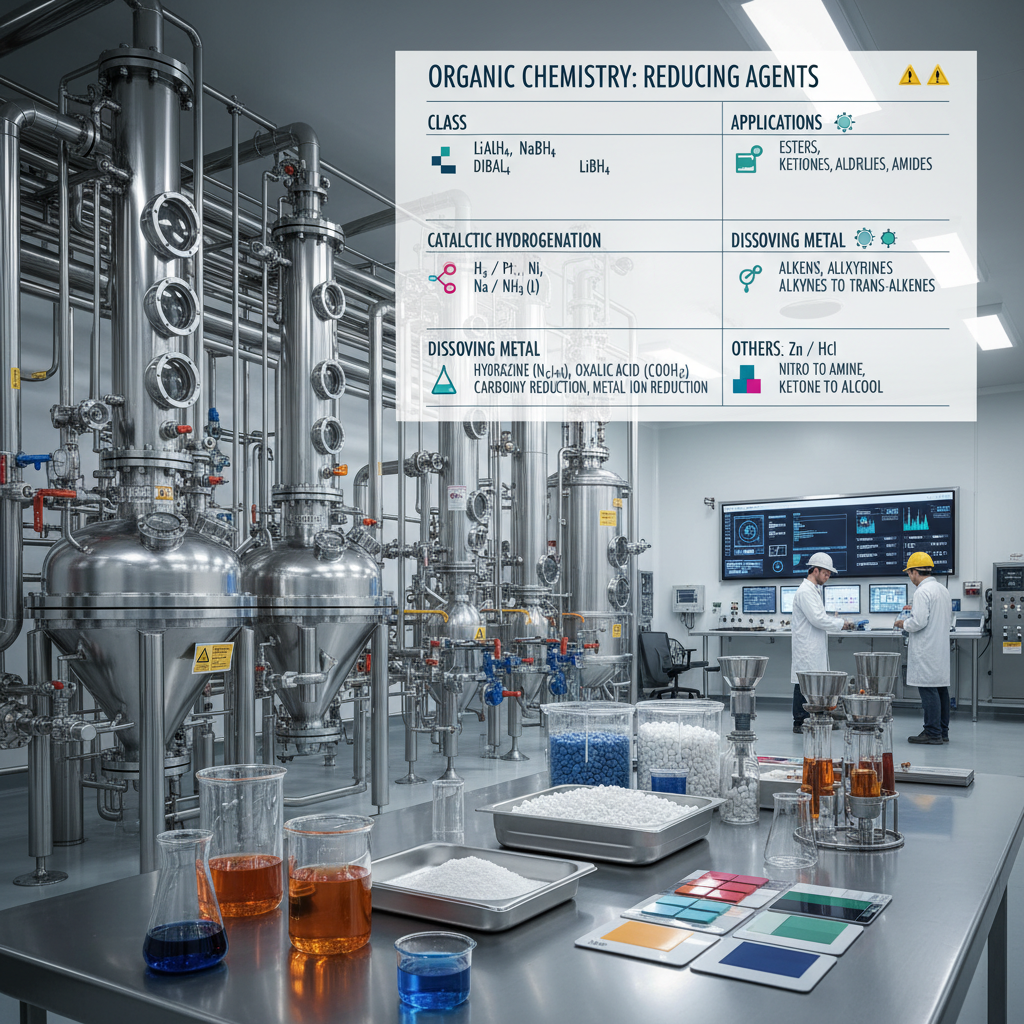
Here's a list of some of the most commonly used reducing agents in organic chemistry, categorized by their reactivity and typical applications. We'll cover metal hydrides, catalytic hydrogenation, and other important reducing agents.
Comparing the Reducing Power of Common Agents
Understanding the relative strengths of reducing agents is critical for predicting reaction outcomes. LiAlH4 is the most powerful reducing agent on our list, capable of reducing a wide range of functional groups. NaBH4 is milder and more selective, often preferred when only aldehydes or ketones need to be reduced. Catalytic hydrogenation offers a versatile method, but its reactivity can be influenced by the choice of catalyst and reaction conditions. DIBAL-H provides a useful intermediate level of reactivity, allowing for the controlled reduction of esters to aldehydes.
Selective Reduction with Reducing Agents
Selective reduction is a key concept in organic synthesis. By carefully choosing the reducing agent and reaction conditions, chemists can reduce one functional group in a molecule while leaving others untouched. For instance, if a molecule contains both a ketone and a carboxylic acid, NaBH4 can selectively reduce the ketone without affecting the carboxylic acid. This selectivity is based on the relative reactivity of the functional groups and the reducing power of the agent. You can find a wide range of chemical products and reagents, including these crucial reducing agents, at Dyeingchem.com.
Factors Influencing Reduction Reactions
Several factors can influence the outcome of a reduction reaction. The solvent used can affect the reactivity of the reducing agent. Protic solvents (like alcohols) can react with metal hydrides, decreasing their effectiveness. Temperature also plays a role, with lower temperatures often favoring selectivity. Steric hindrance around the functional group to be reduced can also impact the reaction rate. Finally, the presence of other functional groups in the molecule can sometimes interfere with the reduction process, leading to unwanted side products.
Conclusion: Mastering the Art of Reduction
Successfully employing reducing agents requires a solid understanding of their reactivity, selectivity, and the factors that influence reduction reactions. By carefully considering these aspects, organic chemists can achieve precise control over their syntheses and create complex molecules with high efficiency. Continued practice and exploration of different reducing agents are key to mastering this fundamental chemical transformation.
Frequently Asked Questions (FAQs)
What are the safety precautions when working with LiAlH4?
LiAlH4 is a highly reactive and potentially dangerous reagent. It reacts violently with water and protic solvents, releasing flammable hydrogen gas. Therefore, it must be handled under anhydrous conditions, typically in an inert atmosphere (nitrogen or argon). Always wear appropriate personal protective equipment (PPE), including gloves, safety glasses, and a lab coat. Never add water directly to LiAlH4; instead, quench any excess reagent with a careful addition of ethyl acetate followed by a saturated solution of sodium sulfate. Proper training and adherence to safety protocols are essential when working with this reagent.
Can NaBH4 reduce carboxylic acids?
Typically, NaBH4 is not strong enough to directly reduce carboxylic acids. However, carboxylic acids can be reduced to alcohols with NaBH4 if they are first converted to their corresponding acyl chlorides or esters. This is because the carbonyl carbon in acyl chlorides and esters is more electrophilic and thus more susceptible to reduction. For direct reduction of carboxylic acids, a stronger reducing agent like LiAlH4 is required.
What is the role of a catalyst in catalytic hydrogenation?
In catalytic hydrogenation, the metal catalyst (e.g., Pd/C, Pt/C, Ni) provides a surface on which hydrogen molecules can adsorb and dissociate into hydrogen atoms. These hydrogen atoms then react with the unsaturated bond (e.g., alkene or alkyne) in a stepwise manner, leading to reduction. The catalyst lowers the activation energy of the reaction, allowing it to proceed at a reasonable rate and under milder conditions. Different catalysts exhibit varying degrees of activity and selectivity depending on the substrate.
How do I choose the right reducing agent for a specific reaction?
Selecting the appropriate reducing agent involves considering several factors: the functional group you want to reduce, the presence of other sensitive functional groups in the molecule, and the desired selectivity. If you need a powerful reducing agent to reduce a wide range of functional groups, LiAlH4 is a good choice. For selective reduction of aldehydes and ketones, NaBH4 is often preferred. Catalytic hydrogenation is useful for reducing alkenes and alkynes. DIBAL-H allows for controlled reduction of esters to aldehydes. Carefully consider these factors to ensure a successful and efficient reduction.