Comprehensive Guide to Textile Auxiliaries and Chemicals with Processes Formulations PDF
Comprehensive Guide to Textile Auxiliaries and Chemicals with Processes Formulations PDF
Textile Auxiliaries and Chemicals with Processes & Formulations PDF
The textile industry relies heavily on a diverse range of textile auxiliaries and chemicals to achieve desired fabric properties, enhance processing efficiency, and meet stringent quality standards. Understanding these chemicals, their applications, and optimal formulations is crucial for textile manufacturers. This article provides an in-depth overview of textile auxiliaries and chemicals, focusing on their roles in various processes, common formulations, and where to find comprehensive resources, including PDF documentation detailing processes and formulations. We will explore how these chemicals impact fabric performance and the importance of selecting the right products for specific applications.
Understanding Textile Auxiliaries: A Broad Overview
Textile auxiliaries are substances added during various stages of textile processing – from pretreatment to finishing – to improve the efficiency of processes and enhance the quality of the final product. They don’t impart color themselves but are vital for achieving consistent and desirable results. These auxiliaries can be categorized based on their function: wetting agents, dispersing agents, leveling agents, sequestering agents, anti-foaming agents, and softening agents. Choosing the right auxiliary is dependent on the fibre type, dyeing method, and desired fabric properties. Dyeingchem offers a comprehensive range of these auxiliaries, tailored to diverse textile needs.
Key Chemical Categories in Textile Processing
Beyond auxiliaries, numerous chemicals are integral to textile processing. These include dyes (reactive, direct, disperse, etc.), bleaching agents (hydrogen peroxide, sodium hypochlorite), sizing agents (starch, PVA), and finishing agents (resins, water repellents). Each category serves a specific purpose. For example, bleaching agents prepare the fabric for dyeing by removing natural pigments, while sizing agents enhance yarn strength during weaving. Finishing agents provide special properties like wrinkle resistance or water repellency. The selection of these chemicals impacts both the quality and sustainability of textile production.
Formulations and Processes: An Example – Reactive Dyeing
Let's consider reactive dyeing, a common process for cellulosic fibers like cotton. A typical formulation includes the reactive dye, sodium carbonate (alkali to fix the dye), a leveling agent for even dye distribution, a sequestering agent to remove metal ions, and possibly a defoamer. The dyeing process involves wetting the fabric, adding the dye and auxiliaries, heating the bath, rinsing, and finally, drying. Optimizing the formulation and process parameters (temperature, time, pH) is crucial for achieving vibrant, colorfast results. Detailed process and formulation PDFs are available from Dyeingchem.
Key Considerations for Reactive Dyeing: Maintaining the correct pH, ensuring adequate dye exhaustion, preventing dye hydrolysis, and proper rinsing to remove unfixed dye.
Comparing Different Wetting Agents for Pretreatment
Pretreatment is a critical step involving cleaning and preparing the fabric for subsequent processes. Wetting agents facilitate the penetration of water and chemicals into the fabric. Different types exist, including non-ionic, anionic, and cationic. Here's a comparison of common options:
Finding Reliable Resources: Textile Auxiliaries and Chemicals with Processes & Formulations PDF
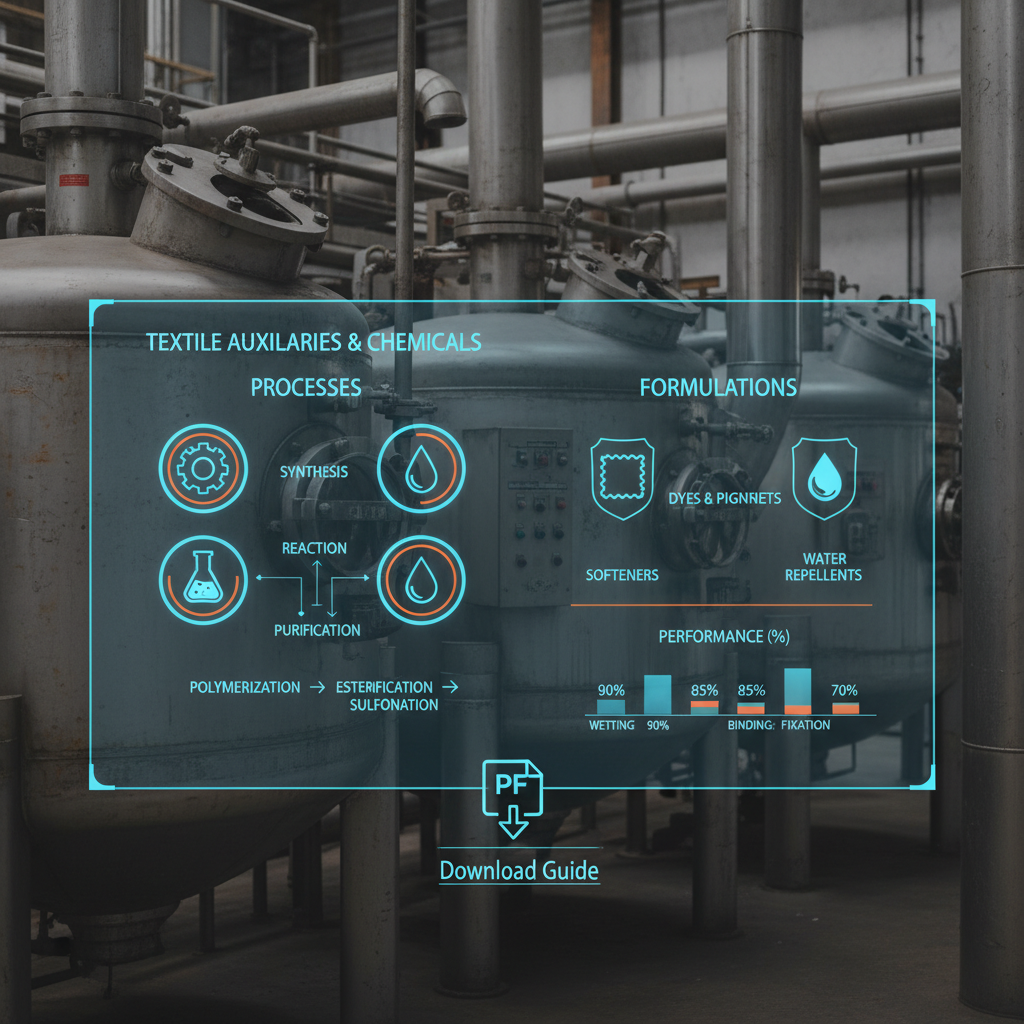
Accessing comprehensive technical information, including detailed processes and formulations, is essential for optimizing textile production. Dyeingchem provides a valuable resource for textile professionals. Their website offers a wide range of textile auxiliaries and chemicals along with downloadable PDF documents outlining specific application guidelines, formulations, and process parameters. These resources are invaluable for ensuring optimal performance and achieving high-quality results.
Conclusion: Optimizing Textile Processes with Knowledge and Resources
A thorough understanding of textile auxiliaries and chemicals, coupled with access to reliable resources like those offered by Dyeingchem, is paramount for success in the modern textile industry. By leveraging the right knowledge and high-quality products, manufacturers can enhance efficiency, improve product quality, and meet the evolving demands of the market.
Frequently Asked Questions (FAQs)
What are the key environmental concerns related to textile chemicals?
The textile industry has historically been associated with significant environmental impacts due to the use of hazardous chemicals. Concerns include water pollution from dye effluents, the release of volatile organic compounds (VOCs), and the persistence of certain chemicals in the environment. Sustainable alternatives, such as bio-based chemicals and closed-loop processing systems, are increasingly being adopted to minimize these impacts. Proper waste management and effluent treatment are also critical. Dyeingchem is committed to providing environmentally responsible chemical solutions.
How important is pH control in textile processing?
pH control is absolutely critical in numerous textile processes. For example, in dyeing, the pH influences dye solubility, dye-fiber interaction, and the overall colorfastness. In pretreatment processes like scouring and bleaching, pH affects the efficiency of chemical reactions and the removal of impurities. Maintaining the optimal pH range ensures consistent results and prevents damage to the fabric. Precise pH monitoring and adjustment are essential for high-quality textile production.
Where can I find detailed formulations for specific textile processes?
Detailed formulations for various textile processes are often proprietary, but Dyeingchem provides a comprehensive library of technical resources, including downloadable PDF documents outlining recommended formulations and process parameters for a wide range of applications. These resources are regularly updated to reflect the latest advancements in textile chemistry and technology. Consulting with a textile chemical specialist can also provide tailored formulation advice.
What’s the difference between a dye and a pigment?
Dyes are soluble in the application medium and form a chemical bond with the fiber, leading to excellent colorfastness. Pigments, on the other hand, are insoluble and are applied to the fabric surface with a binder. While pigments are generally more lightfast, they often result in a stiffer handle and may have lower wash fastness compared to dyed fabrics. The choice between dye and pigment depends on the desired fabric properties and the specific application.