Understanding the Roles of Oxidizing and Reducing Agent in Chemical Processes
Understanding the Roles of Oxidizing and Reducing Agent in Chemical Processes
Understanding Oxidizing and Reducing Agents in Chemical Processes
In the realm of chemistry, understanding oxidizing and reducing agents is fundamental. These agents play critical roles in countless chemical reactions across industries like textiles, pharmaceuticals, water treatment, and more. This article aims to clearly explain these concepts, detailing their functions, applications, and distinctions. We'll explore how these agents impact chemical processes and highlight their importance in achieving desired outcomes. Whether you are a seasoned chemist or a student, this guide will provide a comprehensive overview of these essential chemical components.
What are Oxidizing Agents?
An oxidizing agent is a substance that gains electrons from another substance, causing the oxidation of that substance. In essence, it 'steals' electrons. This process results in the oxidizing agent being reduced—its oxidation state decreases. Common oxidizing agents include oxygen, fluorine, chlorine, and potassium permanganate. They are utilized in bleaching, disinfection, and many organic syntheses. The strength of an oxidizing agent is determined by its ability to accept electrons, often measured by its reduction potential. Dyeingchem offers a wide range of high-quality oxidizing agents for diverse applications.
Key Characteristics of Oxidizing Agents:
- Accepts electrons.
- Causes oxidation of other substances.
- Gets reduced in the process.
- High reduction potential.
What are Reducing Agents?
Conversely, a reducing agent is a substance that donates electrons to another substance, causing the reduction of that substance. It’s the ‘giver’ of electrons. As it donates electrons, the reducing agent itself becomes oxidized—its oxidation state increases. Common reducing agents include sodium borohydride, lithium aluminum hydride, and zinc. Reducing agents are critical in metal refining, the synthesis of organic compounds, and as antioxidants. The effectiveness of a reducing agent is linked to its ability to lose electrons, often measured by its oxidation potential.
Benefits of Utilizing Reducing Agents:
• Donates electrons to other substances.
• Causes reduction of other substances.
• Gets oxidized in the process.
• Plays a crucial role in various chemical reactions.
Oxidizing vs. Reducing Agent: A Direct Comparison
Understanding the difference between oxidizing and reducing agents is best clarified through a direct comparison. While they are opposites in function, they are intrinsically linked in redox (reduction-oxidation) reactions. One cannot act without the other. The strength of each agent determines the reaction rate and equilibrium. Choosing the appropriate agent is paramount to achieving the desired chemical outcome. Dyeingchem's expert team can assist in selecting the optimal agent for your specific requirements.
Applications of Oxidizing and Reducing Agents Across Industries
The applications of these agents are widespread. In the textile industry, oxidizing agents like hydrogen peroxide are used for bleaching fabrics. Reducing agents are crucial in dye fixation. In water treatment, chlorine (an oxidizing agent) disinfects water, while reducing agents can remove heavy metals. Pharmaceuticals rely on both types for synthesizing complex molecules. The food industry uses antioxidants (reducing agents) to prevent spoilage. Dyeingchem caters to these diverse industries, supplying high-purity agents tailored to specific applications.
Selecting the Right Oxidizing and Reducing Agent
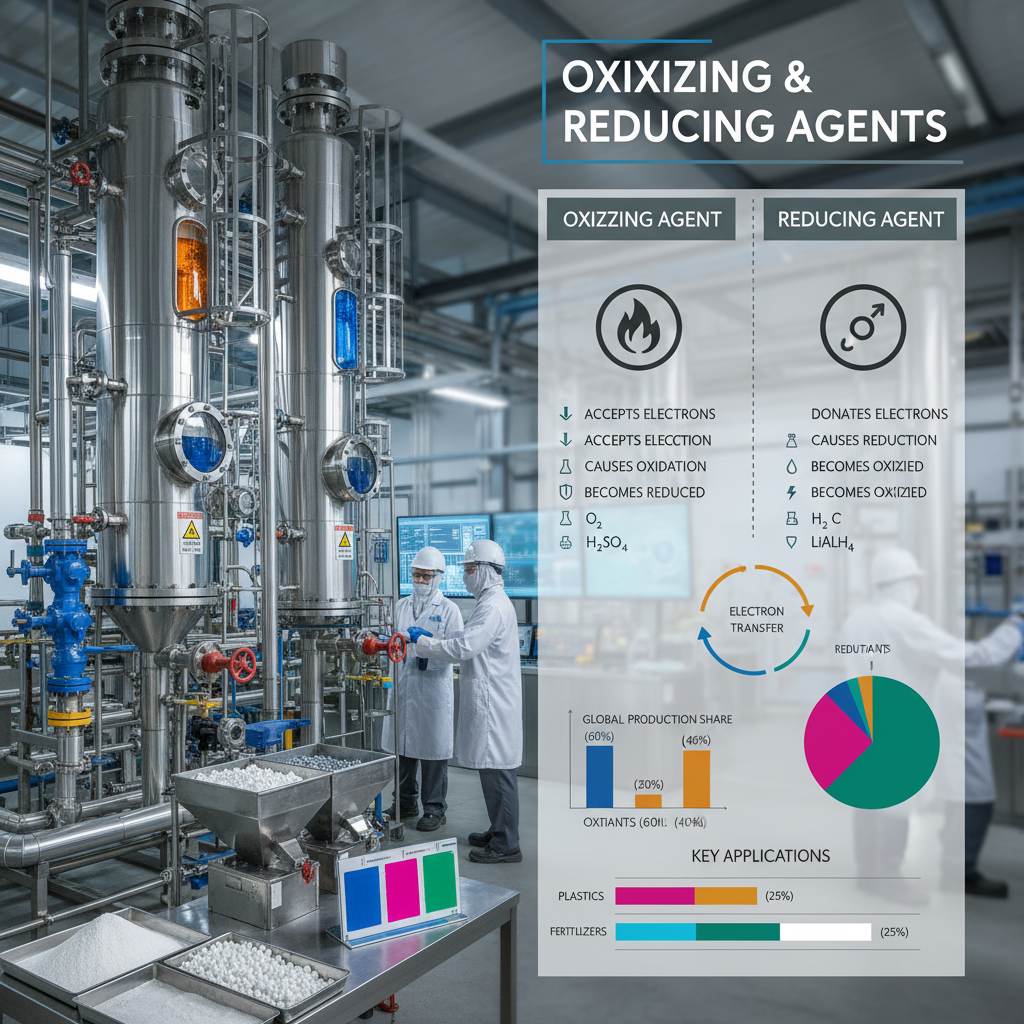
Choosing the correct agent depends on several factors including the specific reaction, required reaction rate, safety considerations, and cost-effectiveness. Factors such as strength, selectivity, and compatibility with other reagents need careful evaluation. It's essential to consider potential byproducts and environmental impact as well. Dyeingchem provides detailed technical data sheets and expert guidance to aid in your selection.
Conclusion: Mastering Redox Chemistry
A thorough understanding of oxidizing and reducing agents is essential for success in various chemical applications. By carefully considering the properties, applications, and selection criteria discussed in this article, you can optimize chemical processes and achieve desired outcomes. Dyeingchem is your trusted partner for high-quality agents and expert support.
Frequently Asked Questions (FAQs)
What is the difference between oxidation and reduction?
Oxidation is the loss of electrons, resulting in an increase in oxidation state, while reduction is the gain of electrons, resulting in a decrease in oxidation state. These two processes always occur simultaneously in a redox reaction. One substance loses electrons (is oxidized) while another gains them (is reduced). Think of it as a transfer – electrons aren't created or destroyed, just moved.
Are oxidizing agents always dangerous?
While many oxidizing agents are powerful and can be hazardous if not handled correctly, not all are inherently dangerous. The level of hazard depends on the specific agent's strength and reactivity. It's crucial to always follow safety protocols, wear appropriate protective equipment, and consult safety data sheets (SDS) before handling any oxidizing agent. Some, like dilute hydrogen peroxide, are relatively safe, while others, like concentrated nitric acid, require extreme caution.
How can I determine the strength of an oxidizing or reducing agent?
The strength of an oxidizing or reducing agent is typically determined by its reduction potential (for oxidizing agents) or oxidation potential (for reducing agents). These values are measured in volts and indicate the agent's tendency to gain or lose electrons. A more positive reduction potential indicates a stronger oxidizing agent, while a more negative oxidation potential indicates a stronger reducing agent. These values are readily available in chemistry reference materials and SDS sheets.
What is the role of a catalyst in redox reactions?
A catalyst does not appear in the overall redox reaction but significantly speeds up the rate at which the reaction reaches equilibrium. It provides an alternative reaction pathway with a lower activation energy, enabling faster electron transfer between the oxidizing and reducing agents. Catalysts are not consumed in the process and can be used repeatedly. They are critical in industrial processes to improve efficiency and reduce reaction times.